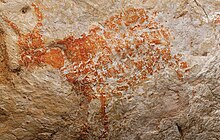
The oldest known figurative painting is a depiction of a bull discovered in the
Lubang Jeriji Saléh cave, painted 40,000 years ago or earlier.

An artistic depiction of a group of Rhinos, was completed in the
Chauvet Cave 30,000 to 32,000 years ago.
Painting is the practice of applying
paint,
pigment,
color or other medium
[1] to a solid surface (called the "matrix" or "support"). The medium is commonly applied to the base with a
brush, but other implements, such as knives, sponges, and
airbrushes, can be used. The final work is also called a painting.
Painting is an important form in the
visual arts, bringing in elements such as
drawing,
gesture (as in
gestural painting),
composition,
narration (as in
narrative art), or
abstraction (as in
abstract art).
[2] Paintings can be naturalistic and representational (as in a
still life or
landscape painting),
photographic, abstract, narrative,
symbolistic (as in
Symbolist art),
emotive (as in
Expressionism), or
political in nature (as in
Artivism).
In
art, the term
painting describes both the act and the result of the action. The support for paintings includes such surfaces as
walls,
paper,
canvas, wood,
glass,
lacquer,
pottery,
leaf,
copper and concrete, and the painting may incorporate multiple other materials including sand, clay, paper, plaster, gold leaf, as well as objects.

Pigment Colours – Classification
Color, made up of
hue,
saturation, and
value, dispersed over a surface is the essence of painting, just as
pitch and
rhythm are the essence of
music. Color is highly subjective, but has observable psychological effects, although these can differ from one culture to the next. Black is associated with mourning in the West, but in the East, white is. Some painters, theoreticians, writers and scientists, including
Goethe,
[3] Kandinsky,
[4] and
Newton,
[5] have written their own
color theory.
Moreover, the use of language is only an abstraction for a color equivalent. The word "
red", for example, can cover a wide range of variations from the pure red of the
visible spectrum of light. There is not a formalized register of different colors in the way that there is agreement on different notes in music, such as
F or
C♯. For a painter, color is not simply divided into basic (primary) and derived (complementary or mixed) colors (like red, blue, green, brown, etc.).
Painters deal practically with
pigments,
[6] so "
blue" for a painter can be any of the blues:
phthalocyanine blue,
Prussian blue,
indigo,
Cobalt blue,
ultramarine, and so on. Psychological and symbolical meanings of color are not, strictly speaking, means of painting. Colors only add to the potential, derived context of meanings, and because of this, the perception of a painting is highly subjective. The analogy with music is quite clear—sound in music (like a C note) is analogous to "light" in painting, "shades" to
dynamics, and "coloration" is to painting as the specific
timbre of musical instruments is to music. These elements do not necessarily form a melody (in music) of themselves; rather, they can add different contexts to it.
Modern artists have extended the practice of painting considerably to include, as one example,
collage, which began with
Cubism and is not painting in the strict sense. Some modern painters incorporate different materials such as
sand,
cement,
straw,
leaves or
wood for their
texture. Examples of this are the works of
Jean Dubuffet and
Anselm Kiefer. There is a growing community of artists who use computers to "paint" color onto a digital "canvas" using programs such as
Adobe Photoshop,
Corel Painter, and many others. These images can be printed onto traditional canvas if required.
Jean Metzinger's mosaic-like
Divisionist technique had its parallel in literature; a characteristic of the alliance between
Symbolist writers and Neo-Impressionist artists:
Rhythm, for artists such as
Piet Mondrian,
[8][9] is important in painting as it is in music. If one defines rhythm as "a pause incorporated into a sequence", then there can be rhythm in paintings. These pauses allow creative force to intervene and add new creations—form, melody, coloration. The distribution of form, or any kind of information is of crucial importance in the given work of art, and it directly affects the aesthetic value of that work. This is because the aesthetic value is functionality dependent, i.e. the freedom (of movement) of perception is perceived as beauty. Free flow of energy, in art as well as in other forms of "
techne", directly contributes to the aesthetic value.
[8]
Music was important to the birth of
abstract art, since music is abstract by nature—it does not try to represent the exterior world, but expresses in an immediate way the inner feelings of the soul.
Wassily Kandinsky often used musical terms to identify his works; he called his most spontaneous paintings "improvisations" and described more elaborate works as "compositions". Kandinsky theorized that "music is the ultimate teacher,"
[10] and subsequently embarked upon the first seven of his ten
Compositions. Hearing tones and chords as he painted, Kandinsky theorized that (for example), yellow is the color of middle
C on a brassy trumpet; black is the color of closure, and the end of things; and that combinations of colors produce vibrational frequencies, akin to chords played on a piano. In 1871 the young Kandinsky learned to play the piano and cello.
[11][12] Kandinsky's stage design for a performance of
Mussorgsky's "
Pictures at an Exhibition" illustrates his "synaesthetic" concept of a universal correspondence of forms, colors and musical sounds.
[13]
The oldest known paintings are at the
Grotte Chauvet in France, which some historians believe are about 32,000 years old. They are engraved and painted using
red ochre and black pigment, and they show horses,
rhinoceros, lions,
buffalo,
mammoth, abstract designs and what are possibly partial human figures. However, the earliest evidence of the act of painting has been discovered in two rock-shelters in
Arnhem Land, in northern Australia. In the lowest layer of material at these sites, there are used pieces of ochre estimated to be 60,000 years old. Archaeologists have also found a fragment of rock painting preserved in a
limestone rock-shelter in the
Kimberley region of North-Western Australia, that is dated 40,000 years old.
[15] There are examples of
cave paintings all over the world—in Italy, France, Spain,
Portugal, China, Australia, Mexico,
[16] etc. In Western cultures,
oil painting and
watercolor painting have rich and complex traditions in style and subject matter. In the East,
ink and color ink historically predominated the choice of media, with equally rich and complex traditions.
The invention of photography had a major impact on painting. In the decades after the first
photograph was produced in 1829,
photographic processes improved and became more widely practiced, depriving painting of much of its historic purpose to provide an accurate record of the observable world. A series of art movements in the late 19th and early 20th centuries—notably
Impressionism,
Post-Impressionism,
Fauvism,
Expressionism,
Cubism, and
Dadaism—challenged the
Renaissance view of the world. Eastern and African painting, however, continued a long history of
stylization and did not undergo an equivalent transformation at the same time.
[citation needed]
Modern and
Contemporary Art has moved away from the historic value of craft and documentation in favour of
concept, leading some to say, in the 1960s, that painting as a serious art form is dead.
[clarification needed] This has not deterred the majority of living painters from continuing to practice painting either as whole or part of their work. The vitality and versatility of painting in the 21st century defies the previous "declarations" of its demise. In an epoch characterized by the idea of
pluralism, there is no consensus as to a representative style of the age. Artists continue to make important works of art in a wide variety of styles and aesthetic
temperaments—their merits are left to the public and the marketplace to judge.
Aesthetics is the study of
art and
beauty; it was an important issue for 18th- and 19th-century philosophers such as
Kant and
Hegel. Classical philosophers like
Plato and
Aristotle also theorized about art and painting in particular. Plato disregarded painters (as well as sculptors) in his philosophical system; he maintained that painting cannot depict the
truth—it is a copy of reality (a shadow of the world of ideas) and is nothing but a
craft, similar to shoemaking or iron casting.
[17] By the time of Leonardo, painting had become a closer representation of the truth than painting was in
Ancient Greece.
Leonardo da Vinci, on the contrary, said that "
Italian:
La Pittura è cosa mentale" ("English:
painting is a thing of the mind").
[18] Kant distinguished between
Beauty and the
Sublime, in terms that clearly gave priority to the former.
[citation needed] Although he did not refer to painting in particular, this concept was taken up by painters such as
J.M.W. Turner and
Caspar David Friedrich.
Hegel recognized the failure of attaining a universal concept of beauty and, in his aesthetic essay, wrote that painting is one of the three "romantic" arts, along with
Poetry and
Music, for its
symbolic, highly intellectual purpose.
[19][20] Painters who have written theoretical works on painting include
Kandinskyand
Paul Klee.
[21][22] In his essay, Kandinsky maintains that painting has a spiritual value, and he attaches
primary colors to essential feelings or concepts, something that
Goethe and other writers had already tried to do.
Iconography is the study of the content of paintings, rather than their style.
Erwin Panofsky and other
art historians first seek to understand the things depicted, before looking at their meaning for the viewer at the time, and finally analyzing their wider cultural, religious, and social meaning.
[23]
In 1890, the Parisian painter
Maurice Denis famously asserted: "Remember that a painting—before being a warhorse, a naked woman or some story or other—is essentially a flat surface covered with colors assembled in a certain order."
[24] Thus, many 20th-century developments in painting, such as
Cubism, were reflections on the
means of painting rather than on the external world—
nature—which had previously been its core subject. Recent contributions to thinking about painting have been offered by the painter and writer
Julian Bell. In his book
What is Painting?, Bell discusses the development, through history, of the notion that paintings can express feelings and ideas.
[25] In
Mirror of The World, Bell writes:
Different types of paint are usually identified by the medium that the pigment is suspended or embedded in, which determines the general working characteristics of the paint, such as
viscosity,
miscibility,
solubility, drying time, etc.
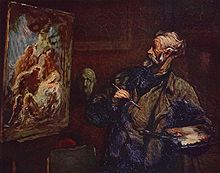
Honoré Daumier (1808–79),
The Painter. Oil on panel with visible brushstrokes.
Oil painting is the process of painting with
pigments that are bound with a medium of
drying oil, such as
linseed oil, which was widely used in early modern Europe. Often the oil was boiled with a resin such as pine resin or even
frankincense; these were called 'varnishes' and were prized for their body and gloss. Oil paint eventually became the principal medium used for creating artworks as its advantages became widely known. The transition began with
Early Netherlandish painting in northern Europe, and by the height of the
Renaissance oil painting techniques had almost completely replaced
tempera paints in the majority of Europe.
Pastel is a painting medium in the form of a stick, consisting of pure powdered pigment and a binder.
[27] The pigments used in pastels are the same as those used to produce all colored art media, including
oil paints; the binder is of a neutral hue and low
saturation. The color effect of pastels is closer to the natural dry pigments than that of any other process.
[28] Because the surface of a pastel painting is fragile and easily smudged, its preservation requires protective measures such as framing under glass; it may also be sprayed with a
fixative. Nonetheless, when made with permanent pigments and properly cared for, a pastel painting may endure unchanged for centuries. Pastels are not susceptible, as are paintings made with a fluid medium, to the cracking and discoloration that result from changes in the color, opacity, or dimensions of the medium as it dries.
Acrylic paint is fast drying paint containing pigment suspension in
acrylic polymer
emulsion. Acrylic paints can be diluted with water, but become water-resistant when dry. Depending on how much the paint is diluted (with water) or modified with acrylic gels, media, or pastes, the finished acrylic painting can resemble a
watercolor or an
oil painting, or have its own unique characteristics not attainable with other media. The main practical difference between most acrylics and oil paints is the inherent drying time. Oils allow for more time to blend colors and apply even glazes over under-paintings. This slow drying aspect of oil can be seen as an advantage for certain techniques, but may also impede the artist's ability to work quickly.
Watercolor is a painting method in which the paints are made of pigments suspended in a water-soluble vehicle. The traditional and most common support for watercolor paintings is paper; other supports include
papyrus, bark papers, plastics,
vellum or
leather,
fabric, wood and
canvas. In East Asia, watercolor painting with inks is referred to as
brush painting or scroll painting. In
Chinese,
Korean, and
Japanese painting it has been the dominant medium, often in monochrome black or browns. India,
Ethiopia and other countries also have long traditions.
Finger-painting with watercolor paints originated in China. Watercolor pencils (water-soluble color pencils) may be used either wet or dry.
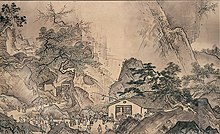
Landscapes of the Four Seasons(1486),
Sesshū Tōyō. Ink and light color on paper.
Ink paintings are done with a liquid that contains pigments and/or
dyes and is used to color a surface to produce an image,
text, or
design. Ink is used for drawing with a
pen,
brush, or
quill. Ink can be a complex medium, composed of
solvents, pigments, dyes,
resins,
lubricants, solubilizers,
surfactants,
particulate matter,
fluorescers, and other materials. The components of inks serve many purposes; the ink’s carrier, colorants, and other additives control flow and thickness of the ink and its appearance when dry.
Encaustic painting, also known as hot wax painting, involves using heated
beeswax to which colored pigments are added. The liquid/paste is then applied to a surface—usually prepared wood, though
canvas and other materials are often used. The simplest encaustic mixture can be made from adding pigments to beeswax, but there are several other recipes that can be used—some containing other types of
waxes,
damar resin,
linseed oil, or other ingredients. Pure, powdered pigments can be purchased and used, though some mixtures use oil paints or other forms of pigment. Metal tools and special brushes can be used to shape the paint before it cools, or heated metal tools can be used to manipulate the wax once it has cooled onto the surface. Other materials can be encased or
collaged into the surface, or layered, using the encaustic medium to adhere it to the surface.
The technique was the normal one for ancient Greek and Roman panel paintings, and remained in use in the Eastern Orthodox
icon tradition.
Fresco is any of several related
mural painting types, done on
plaster on walls or ceilings. The word fresco comes from the
Italian word
affresco [afˈfresːko], which derives from the Latin word for
fresh. Frescoes were often made during the Renaissance and other early time periods.
Buon fresco technique consists of painting in pigment mixed with water on a thin layer of wet, fresh
lime mortar or
plaster, for which the Italian word for plaster,
intonaco, is used.
A secco painting, in contrast, is done on dry plaster (
secco is "dry" in Italian). The pigments require a binding medium, such as
egg (
tempera), glue or
oil to attach the pigment to the wall.
Gouache is a water-based paint consisting of pigment and other materials designed to be used in an opaque painting method. Gouache differs from
watercolor in that the particles are larger, the ratio of pigment to water is much higher, and an additional, inert, white pigment such as
chalk is also present. This makes gouache heavier and more opaque, with greater reflective qualities. Like all watermedia, it is diluted with water.
[29]
Enamels are made by painting a substrate, typically metal, with powdered glass; minerals called color oxides provide coloration. After firing at a temperature of 750–850 degrees Celsius (1380–1560 degrees Fahrenheit), the result is a fused lamination of glass and metal. Unlike most painted techniques, the surface can be handled and wetted Enamels have traditionally been used for decoration of precious objects,
[30] but have also been used for other purposes.
Limoges enamel was the leading centre of Renaissance enamel painting, with small religious and mythological scenes in decorated surrounds, on plaques or objects such as
salts or caskets. In the 18th century, enamel painting enjoyed a vogue in Europe, especially as a medium for
portrait miniatures.
[31] In the late 20th century, the technique of porcelain enamel on metal has been used as a durable medium for outdoor murals.
[32]
Aerosol paint (also called spray paint) is a type of paint that comes in a sealed pressurized container and is released in a fine spray mist when depressing a
valve button. A form of
spray painting,
aerosol paint leaves a smooth, evenly coated surface. Standard sized cans are portable, inexpensive and easy to store. Aerosol
primer can be applied directly to bare metal and many plastics.
Speed, portability and permanence also make aerosol paint a common
graffiti medium. In the late 1970s, street graffiti writers' signatures and murals became more elaborate and a unique style developed as a factor of the aerosol medium and the speed required for illicit work. Many now recognize graffiti and street art as a unique art form and specifically manufactured aerosol paints are made for the graffiti artist. A
stencil protects a surface, except the specific shape to be painted. Stencils can be purchased as movable letters, ordered as professionally cut
logos or hand-cut by artists.
Tempera, also known as egg tempera, is a permanent, fast-drying painting medium consisting of colored pigment mixed with a water-soluble
binder medium (usually a glutinous material such as egg yolk or some other
size). Tempera also refers to the paintings done in this medium. Tempera paintings are very long lasting, and examples from the first centuries CE still exist. Egg tempera was a primary method of painting until after 1500 when it was superseded by the invention of
oil painting. A paint commonly called tempera (though it is not) consisting of pigment and glue size is commonly used and referred to by some manufacturers in America as
poster paint.
Water miscible oil paints (also called "water soluble" or "water-mixable") is a modern variety of
oil paint engineered to be thinned and cleaned up with water, rather than having to use chemicals such as
turpentine. It can be mixed and applied using the same techniques as traditional oil-based paint, but while still wet it can be effectively removed from brushes, palettes, and rags with ordinary soap and water. Its water solubility comes from the use of an
oil medium in which one end of the
molecule has been altered to bind loosely to water molecules, as in a
solution.
Digital painting is a method of creating an art object (painting) digitally and/or a technique for making digital art in the computer. As a method of creating an art object, it adapts traditional painting medium such as
acrylic paint,
oils,
ink,
watercolor, etc. and applies the pigment to traditional carriers, such as woven canvas cloth, paper, polyester etc. by means of
computer software driving
industrial robotic or office machinery (printers). As a technique, it refers to a
computer graphicssoftware program that uses a
virtual canvas and virtual painting box of brushes, colors and other supplies. The virtual box contains many instruments that do not exist outside the computer, and which give a
digital artwork a different look and feel from an artwork that is made the traditional way. Furthermore, digital painting is not 'computer-generated' art as the computer does not automatically create images on the screen using some mathematical calculations. On the other hand, the artist uses his own painting technique to create the particular piece of work on the computer.
[33]
Style is used in two senses: It can refer to the distinctive visual elements, techniques and methods that typify an
individual artist's work. It can also refer to the
movement or school that an artist is associated with. This can stem from an actual group that the artist was consciously involved with or it can be a category in which art historians have placed the painter. The word 'style' in the latter sense has fallen out of favor in academic discussions about contemporary painting, though it continues to be used in popular contexts. Such movements or classifications include the following:
Modernism describes both a set of cultural tendencies and an array of associated
cultural movements, originally arising from wide-scale and far-reaching changes to
Western society in the late 19th century and early 20th century. Modernism was a revolt against the conservative values of
realism.
[34][35] The term encompasses the activities and output of those who felt the "traditional" forms of art, architecture, literature, religious faith, social organization and daily life were becoming outdated in the new economic, social and political conditions of an emerging fully industrialized world. A salient characteristic of modernism is self-consciousness. This often led to experiments with form, and work that draws attention to the processes and materials used (and to the further tendency of abstraction).
[36]
The first example of modernism in painting was
impressionism, a school of painting that initially focused on work done, not in studios, but outdoors (
en plein air). Impressionist paintings demonstrated that human beings do not see objects, but instead see light itself. The school gathered adherents despite internal divisions among its leading practitioners, and became increasingly influential. Initially rejected from the most important commercial show of the time, the government-sponsored
Paris Salon, the
Impressionists organized yearly group exhibitions in commercial venues during the 1870s and 1880s, timing them to coincide with the official Salon. A significant event of 1863 was the
Salon des Refusés, created by
Emperor Napoleon III to display all of the paintings rejected by the Paris Salon.
Action painting, sometimes called
gestural abstraction, is a style of painting in which paint is spontaneously dribbled, splashed or smeared onto the canvas, rather than being carefully applied.
[40]The resulting work often emphasizes the physical act of painting itself as an essential aspect of the finished work or concern of its artist. The style was widespread from the 1940s until the early 1960s, and is closely associated with
abstract expressionism (some critics have used the terms "action painting" and "abstract expressionism" interchangeably).
Other modernist styles include:
The term
outsider art was coined by
art critic Roger Cardinal in 1972 as an English synonym for art brut (
French: [aʁ bʁyt], "raw art" or "rough art"), a label created by
French artist Jean Dubuffet to describe
art created outside the boundaries of official culture; Dubuffet focused particularly on art by
insane-asylum inmates.
[41] Outsider art has emerged as a successful art marketing category (an annual Outsider Art Fair has taken place in New York since 1992). The term is sometimes misapplied as a catch-all marketing label for art created by people outside the mainstream "art world," regardless of their circumstances or the content of their work.
Photorealism is the genre of painting based on using the camera and photographs to gather information and then from this information, creating a painting that appears to be very realistic like a
photograph. The term is primarily applied to paintings from the United States
art movement that began in the late 1960s and early 1970s. As a full-fledged art movement, Photorealism evolved from
Pop Art[42][43][44] and as a counter to
Abstract Expressionism.
Hyperrealism is a genre of painting and sculpture resembling a high-resolution
photograph.
Hyperrealism is a fully fledged school of
art and can be considered an advancement of Photorealism by the methods used to create the resulting paintings or sculptures. The term is primarily applied to an independent art movement and art style in the United States and Europe that has developed since the early 2000s.
[45]
Surrealism is a cultural movement that began in the early 1920s, and is best known for the artistic and literary production of those affiliated with the
Surrealist Movement. Surrealist artworks feature the element of surprise, the uncanny, the unconscious, unexpected juxtapositions and
non sequitur; however, many Surrealist artists and writers regard their work as an expression of the philosophical movement first and foremost, with the works being an artifact. Leader
André Breton was explicit in his assertion that Surrealism was above all a revolutionary movement.



,_oil_on_canvas,_73_x_54_cm_DSC05359...jpg)


.jpg)


